Author Archives: Liv Strand

Dear swarm-I, a room swarming of we-me-s

2022, 2023

Exhibited at Haninge konsthall in the spring 2023, showed at celsius projects, Malmö and another version inaugurated the new art platform CPR² in Brooklyn in 2022

Dear swarm-I, a room swarming of we-me-s is an installed text piece. Large papers form a room to read. How does one read one’s way through a room? How do we read a space?
Paper and documents carry different meanings in our lives, the reading activity becomes a way of tracing and connecting intentions. Large amounts of paper pass through our hands: agreements, letters, instructions, notes, books. The texts in the exhibition Dear swarm-I, a room swarming… are written by the artist and suggest various exchanges between subject and subjects and situations, following Gilbert Simondon’s concept intersubjectivity.

It’s about how one is created in inspiration of and in friction with others – people, phenomena and things. Paper as a material is affected by the handling, if it breaks a fold is imprinted. How the light falls over the surface tells about fibers, roughness and might also create transparency. The papers in Dear swarm-I, a room swarming… have hand-printed text and is the result of a year’s ongoing printing process.

The opening at Haninge konsthall was celebrated with a new performance.

veckad rytm

2020 and ongoing

Veckad rytm premiered under the umbrella project PublikMusik at SITE/Specific festival at Hallen in Farsta, Stockholm 2020, and played again at Weld 2021 and in the exhibition Dear Swarm I… @celsiusprojects, Malmö, 2022.
In 2023 Veckad rytm was shared in several great contexts, as the Abysse festival at Handenterminalen, Haninge, at Hana Erdmann’s music salon and in the festive event of the
90 years celebration of Fylkingen, the prominent experimental stage in Stockholm.

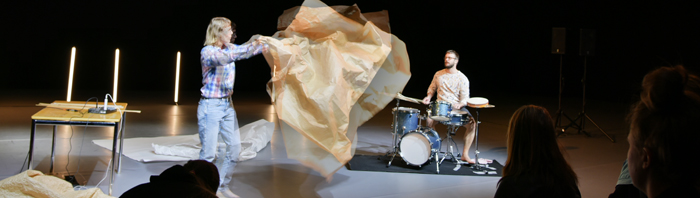
In Veckad rytm, the sound of the paper is inserted into a rhythm-creating practice with Marcus Doverud and Liv Strand. Doing as a way to know.

As to its composition Veckad rytm is spatial, choreographic and material. Brought together by means of improvisation, were different sound worlds and sonic cultures meet, clash and resonates with each other. A sonorous crinkle, meets a rhythmic lick. An aggressive shaking paper body, like rustling leaves, meets the dryness of a drumhead. A suggestive beat, a deflated sound. It is in and through the listening this “music” emerges. Juxtaposing the routinely performed practice of a pattern and the momentous emergence pose questions to the composite of body, space, materials and performance. The composition is the continuous sonorous comparing and juxtaposing, performed through improvisation. Improvisation as the boldness of not knowing what will happen next, and also improvisation as being able to act out of the prior knowledge one has.

The origin of our collaboration veckad rytm was project PublikMusik #1-3, in 2020 curated and choreographed by Marcus Doverud together with Anna Lindal, Roberto N Peyre and Liv Strand.
PublikMusik is a project by Marcus Doverud in care for choreographic and music practices that complicate virtuosity in relation to listening and playing. Studying and mixing competence from different fields we make compositions of sound, movement and materials. A playing-field for thinking with music through choreographic composition. And an attempt to deploy the possible democratic potency of seeing and listening together in a room.
Read more about:
Marcus Doverud
Anna Lindal

Roberto N Peyre

Video of performance at Hana Erdmann’s music salon, summer 2023

A Walk in the Park

2019

Performance A Walk in the Park was part of the program A Common Ground at The Queens Museum and took place as a guided walk in Flushing Meadows-Corona Park.

In relation to the over arching project The Trans Atlantic Meeting on Nationalism(s), which
A Common Ground
was part of, I formulated and held the workshop Migrating Roots aiming to share practices and experiences of belonging and nationalism. It took place at the Finnish Institute in NYC.
Curators Susanne Ewerlöf & Carmen Ferreyra, Curatorial Program for Research.

A Walk in the Park in the Flushing Meadow-Corona Park as a text:
Exit the Queens Museum of Art and enter into the park, the Flushing Meadow-Corona Park. Leaving the architecture behind, the straight vertical surfaces get replaced by shifting green. And brown obstacles and enclosing bodies of growth. What is the façade of a park, a green space? If it shows a specific era, it does so to initiated persons with garden knowledge. Perhaps it presents local crops and native plants, maybe in mix with migrating trees and flowers. Brought across the planet because their beauty, their willingness to grow, or other reasons. An architectural façade shows power, it shows a level of maintenance and perhaps neglect of attention. The façade is an impression, a presentation, an aesthetic identity of that single place. The façade of the park is more on the ground, in the layout of green surfaces and pathways.

The layout of the Flushing Meadow-Corona Park rests on several histories. It was the location for two New York’s World Fairs, one in 1939-40 and the next in 1964-65. Both echo in the naming of the streets crossing through the park: close up to the Queens Museum is the Avenue of the States. Enclosing the Unisphere monument is the United Nations Avenues North and South, and radiating out from the Unisphere runs the Avenue of the Americas (towards north) and the Avenue of Africa. All spread as a map of the world collected in a green space. This way of naming speaks of times when the world was still considered to be ONE, an entity with one truth, one (best) way of thinking and reasoning. A park, as well as a city, is as much a process as the bricks and seemingly solid surfaces it is made of. The Maloof Skate Park a bit to the south from here is under reconstruction, and there the sign speaks three languages: English, Russian and Chinese. This tells about who the guests, or users, of this park is today. Not one, but several cultures gather here. A being the activity carried out there, the sports, the slow walks, the barbecues, the blankets for resting several hours.

Let us move closer to the Unisphere. It was constructed by landscape architect Gilmore D. Clarke who was the landscape architect for a handful parks in NYC. It was raised for the World Fair in 1964. The competition amongst a handful artists for a monument failed, none of the artistic answers were the wanted one, so Gilmore D. Clarke was asked to solve the situation. What is even more pragmatic about this monument is that it was built for free by US Steel Corporation, in exchange for having their name on the plackets permanently. The Unisphere is a see-through globe in steel and tree metallic lines encircle it representing the three first satellites. This was the dawn of the space battles; to be first, reach furthest away etc. Echoing with renewed strength in our times, now with rouge states sending shuttles to the moon and corporations joining. Here by the Unisphere we can all get a splash of the joy of this technical advances, as a cooling water fume spreads by the winds.

Lets walk on. Look at these trees, they have been here for a long time. I especially like the pine tree over there. Trees move towards empty spaces up in the air, where they can spread their leaves or pine needles and meet the sun rays. They only wanders from one generations seed as far as that can get carried by a bird, the wind or an adventurer. Think of a tree you know well, growing somewhere else than here. Take your time an close your eyes and remember that tree. The colours, the micro climate around or beneath it.

Now we approach the Freedom of Human Spirit, sculpted by Marshall Fredericks 1964. He was an artist from the United States that travelled to Europe for more artistic education, as was the code of his time. One figure of influence for his artistic development was the Swedish artist Carl Milles, who also made these kind of flying, detached fairy-like human creatures. Carl Milles who were accused of being a nazi in the beginning of WW2, and that also reminds of a time where there still was ONE truth, constructed by the power nations of Europe and perhaps even by the US. After WW2 the US definitely was on top of the world. The name of the sculpture: the Freedom of Human Spirit, talks about ideals of Freedom and here I like to quote what Marshall Fredericks himself said about the sculpture:
“I realized that great multitudes of people, of all ages, and from all walks of life would see this sculpture…I tried to design the work so that it was as free of the earth, as free in space as possible…the thought that we can free ourselves from earth, from the material forces which try to restrain and hamper us, is a happy, encouraging and inspiring one, and I sincerely hope that my work will convey this message.”

The detachment to a place that both the figures in the sculpture show is quite different from present concerns about first nations and about the more problematic ramifications the notion of one land, one people with one language and a shared history, formed into nation states, has. I rather get connected and look for peers where interests that can be shared, no matter origin. In our times the sense of being rooted is higher valued than to be free to fly away. Now I get myself messed up in speaking about this in general. A singular narrative forms a place, a location. I get formed by the persons I meet.

The nation state as a form for creating ownership of land. And rules for the ones living there. Normative truth as mechanisms for how we learn reasoning. And the very hard task to collectively imagine some other structures. Together.

Talking about the park as a process, I want us to visit a more recent grove just over here. It is the American-Israeli Friendship Grove, that was completed as late as in 1995. It is created as a tribute to the forming of the nation of Israel in 1948. Israel as a young state, a one-sided formation by the Jewish Agency, after suggestions by the UN 1947. Forming a state on land that was inhabited also by other cultures, with other hopes and wishes for their rule. Israel, as an idea and as reality, was rejected The Arab leaders. History knows about the 6-days war in 1967, and about that the territory still holds several claimers to be the rightful power. Or co-powers. In this part of the park is planted native trees from America and from Israel, a green meeting. Here is also a tree from Lebanon included in the grove, as Lebanon stayed neutral in the war of 1967. Coming from Sweden I can relate to the tricky balance of being a so called neutral nation (even if my father is Norwegian and his family was clearly involved in WW2). In Israel they dig certain layers in their archaeological strive to prove the Jewish right of the lands to be the strongest. Physically. It is a struggle using a mid 18th century idea on previous history, using history for contemporary purposes in a very out spoken manner.

Text written August 2019 in Stockholm.
This script is a construction concluded a month after the actual performance walk A Walk in the Park took place in the Flushing Meadow-Corona Park. It is made from my intensions, my notes and research for the improvised walk. A walk that did not start at the entrance to the park from the Queens Museum, but was conducted in reverse, as we had to leave at the main entrance to a sunny parking lot and a trafficked highway. So, it functions as a script of a lot that was mentioned, some forgotten, and some material that I wished for, or intended to, include.

Utsikten

Utsikten / The Prediction, an exhibition at Krognoshuset in Lund, Sweden. Featuring an installation with folded and plied lighting filters, and a set of typographic prints on the notion of the nation state (setting borders for people ans imagination) and a large drawing of a lowercase i (font Times New Roman). The exhibition combine abstraction and argumentation. A version of the work was exhibited at Grafikens Hus in exhibition Mellanrummets mekanismer.

utsikten_rad

Utsikten / The prediction

2018

Exhibition at Krognoshuset in Lund,
and in Mellanrummets mekanismer / The mechanisms of the gap together with Tova Fransson presented by Grafikens Hus at Kringlans Konstfönster in Södertälje, curator Ulrika Flink

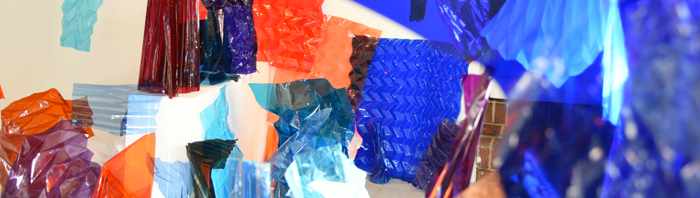
The works in the exhibition The prediction take further a long-lasting interest in the concept of the nation state. What are the mechanisms and influences on ways to reason that the idea of the nation state have? The prediction handles these issues both in a literal sense by texts distributed as typographical posters, and in the practise of folding lighting filters and using their inherent aspect of changing colours when overlapping. It is abstraction and concretion, and touches prevailing questions of inclusion and exclusion. Who are our sense of solidarity encompassing? The prediction explores if complex structural aspects can be creased formally.
Downstairs a 5,5 meter graphite drawing of the letter i rests on the floor. In Swedish i means ‘in’: a word in it self. i also got other connotations.

Axel Andersson writes about Strand’s working methods: ‘Strand engages with material, mechanics and text in order to explore not the nature but the construction of the figurative and the literal. The turn is both simple and profoundly destabilising. The literal, previously a site for the singular and discrete, inherits the multiplicity and open-endedness of the figurative. The physicality of the material, a key component of these works, is ever so much the end point as the starting one. But no thing is the same after having been conceptually stood on its head. Neither is the figurative speech a new symptom literally materialised. Strand’s art transmits a profound and radical understanding of that each position was always already there in the other.’

Last image show a review from 2018-03-03.

From the press text about The mechanisms of the gap:
Liv Strand’s artistic practice centres round the desire to reshape; in a process that provides a space for something that has not yet fully taken form. Strand is originally from Södertälje and studied at the Royal Institute of Art (1999). Through art the conditions for a collective understanding is explored and negotiated – how it is manifested and how it can disappear. In the exhibition are Strand’s beautifully coloured typographic posters included, where poetic texts twist and turn the foundational construction of the nation state, its inner and outer borders. Strand writes; There is an undefined area for longing / desire / aspirations. It leaks.

Post-truth is described as a symptom of a world where objective facts are no longer the basis of how we gather information or relate to knowledge. Personal beliefs, experience, understanding and feelings create gaps and slippages in relation to objective facts. Truth claims falls flat, power disrupts and new spaces emerge in a configuration of tensions between the concrete and the abstract. Absolute truth was abandoned a long time ago. We now embrace complexity, the uncertainty about truth-claims restrict us to the intermediate, grey zones, structures, contexts, and shifting power relations. How we experience the world is coloured by how we meet, code and process sensory stimulation and information. We interpret and reinterpret in a continual on-going process. Like origami, beautiful hand-folded colour filters are part of the installation of the Art Window. Strand’s work alters the sunlight and creates new colours which overlaps in an on-going process.

Both Fransson and Strand’s use of letterpress printing braces against the tradition, stretching and changing the process by making visible the mechanisms of space, the hand and thought in an on-going continual labour.

Signals

2016

S i g n a l s  was an evening I arranged together with Isabel Carvalho (PT) and Jelena Rundqvist (SE) at NFK’s guest studio in Stockholm

S i g n a l s

The invitation red:
We invite you to attend an evening where the attention goes to the mutual concern between people and things. (Imagine) Touching a thing with some shape and a certain material making up the surface. The sensation comes along with prior knowledge, its formulations along with a curiosity, going towards the not yet known, placed in the present moment. Learning and/or confirming. It browses the catalogue of stuff put in our mouth as kids, all one knows about textures. It browses and add news. When describing what happens for someone else communication starts and it is also a material. Gestures, words, texts etc.

S i g n a l s is a programmed evening with two acts at Malongen, and one guided out-door tour. The works handle objects, text and actions providing assiduities in a socio-cultural sphere.

Isabel Carvalho (PT), Jelena Rundqvist (SE) and Liv Strand (SE) will appear with art works during the evening. This event spurs from a summer month working in parallel with a concern for links between objects and text. Isabel Carvalho (PT) visited in July, and then some meetings on text and its materiality was arranged for a larger group of colleagues.

Tja chat, tjena chien, concerning mimetic displacement

2016

Performance work, duration about 30 to 40 minutes

Has been performed at ‘Revolve’ Uppsala performance festival at Uppsala konstmuseum and at Inter Arts Center in Malmö 2016. And in 2017 at My Wild Flag festival in collaboration with Studiekretz @ C.off and ccap, and at Samtidskonstdagarna in Kalmar, invited by Kalmar Konstmuseum and Konstfrämjandet.

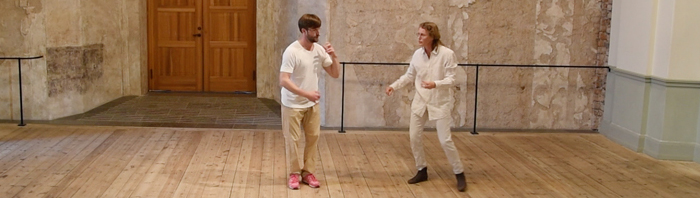
‘Tja chat tjena chien, concerning mimetic displacement’ (Tja chat, tjena chien, om härmning som förskjutning) departs from mime as a concept and a form of delivery. How something can be brought to experience and be understood, coexists with what it is to expose something through embodying it. Giving it another body. The displacement that the mimes brings about has to do with an embodiment. Basic to mime as stage performance is that another body, the imitating one, show a facet of what is mimed. In the work ‘Tja chat tjena chien, concerning mimetic displacement’ imitation also happens by stories we tell. What does it mean to do something together, what it is to become a we? In relation to a climate of increasing competition and focus of the individual, choreographer Marcus Doverud and artist Liv Strand, made this works dealing with intrapersonal influences.

Video from Tja Chat, Tjena Chien, Concerning Mimetic Displacement

Succession for words

2017

one sheet publication, with cover

edition 17 copies

‘Succession for words’ is the outcome of a two week stay at an artist book workshop in Seyðisfjörður, Iceland co. Skaftfell. It is a lino print were two lines of words crosses the shape of the folds of the book.

the void of             abstraction

one memory           prejudice

‘Succession for words’ has an edition of 17, most copies are spread across the globe accompanying the other participants of the workshop.