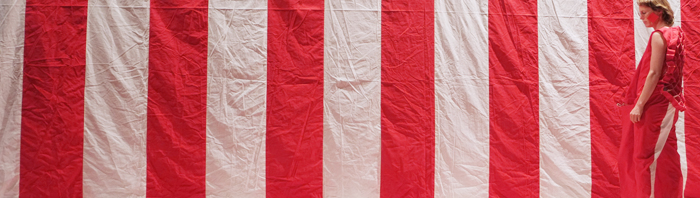
Textile Location is a performance work where a red and white textile set a structure probed by a costume and by text. Text read and recited. Textile Location has been showed at Agora Collective, Berlin, at PALS 2014 –International Festival for Performance Art, at Sunday Run_up @ccap celebrations, and at Slakthuset.
Author Archives: Liv Strand
E t t – 1 0
2014
11 pages
edition 15 copies
Text and typography by the artist
Printed at bbk’s Druckwerkstatt in Berlin using their collection of led and wooden types.
15 copies printed, all with some individual differences in page or text colors. Texts on page 1 – 10 in Swedish with English translations at page 11 written in collaboration with Axel Andersson and Tania Espinoza.
Bachelor thesis on artistic research, Melanie Fahden
2014
Künstlerische Praxis und Forschung: Das Zusammenwirken von wissenschaftlichen Methoden und künstlerischer Praxis am Beispiel des Werks von Liv Strand.
77 pages
Vorgelegt von Melanie Fahden, Elisenstr. 43, 30451 Hannover.
Email: fahden@uni-hildesheim.de
Melanie Fahden’s summary:
Research question: Artistic practice and research: How do artistic practices and scientific methods work together in the artwork of Liv Strand?
This thesis Melanie Fahden wrote in 2014, partly from e-mail conversation between her and me. These are included in page 48 – 72, along with some other documents. The rest of the text is in German. It was a pleasure to get to answer Melanie’s questions.
The thesis is following the question of what artistic research means and how this research format combines artistic practice with scientific methods. At first stands an overview about the recent discussion about the term, field and development of artistic research in the science of art. Then it follows a comparison between artistic and scientific research, in order to get to know differences as well as similarities. What are the chances and what are the risks of this mutual influence? In the second part there is an analysis of some exemplary artworks of Liv Strand. While having a deeper look at “Sliding Structure”, “Quicksand frontier under-standing”, “Through Composition as Explanation” and “Salon Material”, the thesis is discussion the questions of how the artistic practice of Liv Strand works within the field of artistic research. Are there parallels to the theoretical understanding of artistic research or where does the artistic practice of Liv Strand broaden the understanding of artistic research?
Further information: Matrikelnummer: 207598, 7. Fach-/8. Hochschulsemester, Abgabedatum: 28.10.2014.
Stiftung Universität Hildesheim, Fachbereich II: Kulturwissenschaften und Ästhetische Kommunikation, Institut für Bildende Kunst und Kunstwissenschaft, Sommersemester 2014, Bachelorarbeit im Studienfach Kulturwissenschaften und ästhetische Praxis (B.A.).
Erstprüferin: Prof. Dr. Viola Vahrson. Zweitprüfer: Jan Schönfelder.
Textile Location
2014
Perfomance art work that premiered at PALS performance art festival 2014 in Stockholm.
Also showed 2014 at Slakthuset performance program, at Sunday Run_Up at Svarta Huset; and a performance program celebrating ccap 20 years and at Agora Collective, Berlin, 2015 as a Foreplay event.
Textile Location is a performance work with a huge white and red striped textile and a costume that allow the artist to blend into the color fields. The alignment of costume and textile prescribe the movements. There are two different modes of changing from red to white – with a frontal shift, or by a slow half-circle backwards spinning around the shoulder.
Pieces of texts is written to be recited or read as a fundamental part of the performance. The texts deal with binary situations: the two, and tells about various kinds of spatiality.
Excerpts from text recited and read:
(101)
To sense somebody’s grimaces: and just by the movement of the limbs apprehend that it is on it’s way. The coming about of the event reflects in the shivering finger-tips, enforced by a prolonged abdomen –reaching in the direction of a face– then it dazzle instantly, in other muscular tensions than usual. A grimace. A crisp meaning or a contraction that rather informs inward to ones own body. The outward grimace as an imitation or an echo of an internal circumstance.
(102)
A binary situation.
One distinct difference is established.
The same width and length, forming a striped unity where one color field is contiguous to the next. They touch without blending.
(304)
Walking the beach without haste.
Along with… At one-hand-side water spreading out to an ocean.
The waves hit at a pace, the steps drums another.
A trot, a stroll undoubtedly focused: along the beach.
Mediterranean rim, the border of land. Landing conquest. Confront.
The waves roll in, caressing the shore and pulling-it-out-into-the-sea again.
I count on the seventh wave.
They differ in accuracy, there are middle waves and irregular spacings.
Suddenly the presence of color: a pink, a cerise, a green, a yellow-white, a red sweaters in the fisherman’s boat.
They go outward, outgoing. Transversely.
Doing, Showing, Sharing: Ways to Un-pre-scribe Collective Artistic Processes
2013
A paper on my artistic collaborations given at: EMOTIONAL ECONOMY, a workshop on emotional labor and toward dispositions for a new economic ethos. Held in December 2013 by Johns Hopkins University Program for the Study of Women, Gender, and Sexuality on the initiative of Katrin Pahl.
All contributions at the workshop:
– Emotional Labor of Buttressing Masculinity in Tokyo’s Entertainer Clubs, Rhacel Parreñas Sociology, USC
– Care & Theft: Intimate Labor and Female Migration in the Italian Psychological Thriller, Barbara Mennel Film, University of Florida
Discussant: Emma McGlennen Anthropology, JHU
– Doing, Showing, Sharing: Ways to Un-pre-scribe Collective Artistic Processes, Liv Strand Artist, Stockholm
– Fragility and Activism, Bill Connolly Political Theory, JHU
Discussant: Jennifer Watson Art History, JHU
Non Cover
2013
Exhibition at Künstlerhaus Bethanien, Berlin.
The performance drum session was performed in the exhibition one day, during five hours.
In Non Cover the material is made to discuss. How does a surface shows itself and is presented, in comparison with others. What can be conceived as similarities among images and sensations exposed by series of material? In human perceptions differentiating structuring of perceived information helps to form understanding. The kind of distinctions made by matter and the several parts of the exhibition is in focus in Non Cover.
Non Cover was exhibited in two rooms at the Gallery of Künstlerhaus Bethanien; in the entrance and upstairs. One part is a text that was presented glued to the wall in the entrance space along with some more art works. The text is treated as a text-material in parallel to other materials, it has a place and a surface, and content. It is explanatory analog to all parts of Non Cover, all things are made to create meaning, to moving along a shared plane of abstraction; of language and as human sensations.
A drum session took place in Non Cover. A group consisting of Axel, Marcus, Tilda and Pär created rhythms, or not, together with me, the artist. There were not any specific rhythms that we tried to perform. There were some cues for how to listen and think about intensity. We all had individual ways to relate to what drumming can be. The session was as much on how to form a group in drumming, as on drumming as sequences of sounds.
Go to the publication Non Cover.
Drum Session –Non Cover
2013
One day drum session in the exhibition Non Cover.
A drum session took place in the exhibition Non Cover. A group consisting of Axel, Marcus, Tilda and Pär created rhythms – or not – together with the artist. There were not any specific rhythms that we had tried to learn. There were some cues for how to listen and think about intensity. We all had personal ways to relate to what drumming could be. The session was as much on how to form a group in drumming, as on drumming as sequences of sounds.
spoken… 1, 2 + 3
2013
spoken versions 1, 2 + 3 was created for the exhibition The Embassy Reconstructed at the Nordic Embassies in Berlin as part of Transmediale 2013 BWPWAP
This sound work poses questions related to the notion of “internationalism”. It relates to reoccurring periods dedicated to study mechanisms that are involved in nation-building, also involving making sculptures during the course of the process.
How does the formalized structure of communication between nations and head of states via embassies contain ideas of internationalism? How does it relate to a globalized world where the flow of things, money, ideas and ideals aims to be unbound? At the same time as the restrictions for persons to move are tighten. How are people included on a diplomatic level, who are the “we” and who are the “them”? The piece spoken versions 1, 2 + 3 composes a collage out of a series of interviews with employees at the Nordic Embassies, printed as a CD that was handed out during the exhibition.
twice twice
2012
A performance in collaboration with Marcus Doverud
twice twice is a 1,5 hour long composition that premiered at Weld in Stockholm, May 2012
The staged work twice twice filter some of further discussions and practical attempts.
The language of the performance was spoken words or other means as improvised sound/music, choreographed bodily encounter and babble as voices without a specific language, trying to describe and articulate absent objects etc. Running through twice twice is a tone of how the piece operates by insisting on the making in situ, attempting a strictly composed auto poetic production. We worked with what we call ‘concept-objects’, an exercise in verbally exhausting ones knowledge on a topic or a word by telling it.
LARM From mouth cavity to laptop: the sound of Nordic art
2007
275 pages
2 cds included
isbn: 978-91-8968096-8, Kabusa Förlag
Distribution is for the time being handled by us, the old LARM-team
Editors: Maria Bjurestam, Maria Hägglund, Mona Petersson and Liv Strand.
Text Editor: Annika Ruth Persson.
The book, LARM Från munhåla till laptop: ljud i nordisk konst/ LARM From mouth cavity to laptop: the sound of Nordic art, presents a selection from the rich material of the LARM inquiry, exhibiting sound art from different perspectives in thematic texts and presentations of artists. The texts in the book are in the Nordic languages with English translations. Two cds made in collaboration with Kning Disk is included in the book.
Visit the web site larm-festival.se
Texts by: Maja Ratkje, Stine Hebert, Catharina Dyrssen, Natasha Barrett, Yvonne Spielmann, Thomas Millroth, Adina Popescu, Zeenath Hasan, Søssa Jørgensen, Yngvild Færøy, Grethe Melby, Johanna Gustafsson, Anne Hilde Neset, Nina Björk Eliasson, Pauline Oliveros, Maria Bjurestam, Bodil Persson, Ina Blom, Kristin Björk Kristjansdottir, Thor Magnusson, Karl Holmqvist, Mika Hannula, Meena Kaunisto, Elisabet Indra Ragnarsdottir, Liv Strand
Presented by images: Ursula Nistrup, Sandra Andersson, Icelandic Love Corporation, Camille Norment, Unni Gjertsen, Solveig Dufour Andersen, Arijana Kajfes, Hekla Dögg Jónsdóttir, Ann Rosén, Astrid Lomholt, Christine Ödlund, Steina Vasulka, Liv Strand, Marika Orenius, Andrea Lange, Ellen Nyman, Johanna Billing, Tine Louise Kortermand, Lena Mattsson, New Meaning, Mona Petersson, Kristine Scholz, Emi Maeda, Jana Winderen, KOEFF, INgrid Engarås, Ilmur Stefánsdóttir, Ann Kristin Bergesen, Maia Urstad, DK, Kvinder på Værtshus, Ebba Moi, Anna Carin Hedberg, Ásdis Sif Gunnarsdóttir, Vivi Christensen, Marianne Decoster-Taivalkoski, Elina Saloranta, Molly Haslund, Malin Bång, Ida Lundén, Birgitte Alsted, Karin Rehnqvist, Lisa Dillan, Dodda Maggý, Sonja Åkesson, Maria Hägglund, Lisa Jeannin, Lise-Lotte Norelius, Kerstin Ståhl, Bengt Emil Johnson, Sara Lundén, Tanja Stasia Schlander, Ylva Skog, Hugger-Mugger, Gunilla Leander, Ruth Bakke, Maria Bjurestam, Minna Suoniemi, Siri Austen, Maija Hirvanen, Elena Näsänen, Kristine Stubbe Teglbjärg, Päivi Takala, Paulina Sundin, Anna Karin Rynander, Per-Olof Sandberg, Lina Selander, Elisabet Hermodsson, Thurídur Jonsdóttir, Hanna Hartman, Else Marie Pade